What the silence is actually telling you
The post-launch analytics dashboard with nothing on it is one of the most demoralizing sights in indie development. Months of work. A product that functions. And then: zero meaningful traffic, zero signups, zero traction.
The natural instinct is to treat silence as a verdict on the product itself — it didn't work, start over. But as one developer put it in a thread on exactly this experience: "That silence? It's not about your product being bad. Often it's about invisibility. You didn't reach the right people, in the right places, with the right message. You launched and then waited. That was the mistake."
Silence is a diagnosis problem, not a product problem. The difference matters enormously, because the fix for a product problem is rebuilding, and the fix for a diagnosis problem is asking better questions. Rebuilding before you've diagnosed burns months more on the same mistake.
Step 1: Diagnose before you pivot
The hardest part of this step is suppressing the urge to act before you understand. The most common wrong actions after a silent launch: adding features the product doesn't have, redesigning the UI, rebuilding in a different framework, or pivoting to an entirely different idea. All of these skip the actual question: why did the people who saw the product not convert?
The diagnosis starts with five conversations. Find five people who clearly have the problem your product solves — not friends or family, actual people who would be your target user — and ask them to look at your landing page or App Store listing. Three questions that produce useful answers:
- "What do you think this does?" (If their answer doesn't match what your product does, you have a messaging problem, not a product problem)
- "Would you pay for this? Why or why not?" (Listen; don't argue; absorb the gut punches)
- "What would make you trust this enough to sign up?" (Often reveals a credibility gap — no reviews, no screenshots, no evidence it works)
In most cases, the answers to these three questions will point to a messaging problem before a product problem. The developer who shared their experience in the thread discovered exactly this: "I realized my landing page sucked. I was listing features when I should've been talking about the actual pain it solves." Same product. Rewritten positioning. Different results.
Step 2: Fix the message before scaling anything
The most common messaging failure: talking features when users need pain relief. "A tool that does X, Y, and Z" describes the product. "Never spend a Sunday evening on X again" describes the result. People don't buy features — they buy the relief from the problem that's been bothering them.
The specific test: read your landing page or App Store subtitle out loud. Does it describe what your product is, or what your user's life looks like after they use it? The first is a feature description. The second is a value proposition. Only one of them makes a stranger want to click.
For App Store listings, the first screenshot caption is where this matters most. It's the first thing a potential user sees in search results, before they even tap through to your page. "Budget Tracker" tells someone the category. "Know where every dollar went in 30 seconds" tells them what changes. The second version answers the question the searcher is actually asking. ezscreenshots is built for exactly this rewrite — drop in your Simulator screenshot, add an outcome-focused caption, export at the correct dimensions for your device targets.
Step 3: Survival grinding over growth hacking
After a silent launch, the instinct is to look for something that scales — a viral loop, a growth hack, a channel that reaches thousands at once. That's the wrong order of operations. Before anything scales, one person needs to genuinely love what you made.
The recovery phase is manual by design. What it looks like in practice:
- DMs that are helpful, not pitchy. Find threads on Reddit or X where people are describing your exact problem. Reply with something genuinely useful. Then DM: "I noticed you're dealing with [specific thing] — I built something for that, would you want to try it in exchange for 15 minutes of honest feedback?" The context is already there; the pitch lands much softer.
- Show up in communities where your users actually are. Reddit subreddits, Discord servers, niche Slack groups. Not to drop your link — to answer questions, be present, become the person people think of when they have that specific problem. Links come later, after you've built some credibility.
- Solve the problem for one person completely. Not a demo, not a trial — actually solve it. Get on a call, walk them through it, fix whatever breaks in real time. One person who genuinely gets value from your product tells you more than a hundred people who tried and left silently.
One comment from the thread: "Dev = comfortable, outreach = uncomfortable. That's why so many initially good products fall off a cliff. Early outreach beats early dev — you need to know what to build, and where to adjust and pivot." The discomfort of manual outreach is the point. It's slow, it doesn't scale, and it's exactly what's needed to get the first real signal.
Step 4: Pivot or persevere — how to tell the difference
After diagnosis and the first round of manual outreach, you'll have one of two signals:
Signal A: People understand the product and have the problem, but won't pay / won't commit. This is a distribution or credibility problem. You've found the right people, the message is landing, but something in the trust or pricing equation is broken. Fix the credibility signals (add a demo, add social proof, lower the commitment ask) before you change the product.
Signal B: People don't have the problem as acutely as you thought, or the problem exists but they've already solved it well enough. This is a market signal. The core idea may need to pivot — not a full rebuild, but a reframe. The same product repositioned for a different use case or a narrower audience can unlock a market that actually has urgent pain.
The founder who doesn't diagnose first will conflate both signals as "the product is wrong" and rebuild when they needed to reposition — or will persist with the same wrong positioning when the market signal is clear. Five conversations makes the distinction obvious in a way that analytics never will.
Step 5: Go to where your users already are
One of the thread's highest-upvoted observations: "The best advice I ever got is 'go to where your users hang out.'" Not where you want them to be, not where it's convenient to post — where they actually are.
This means different things for different products. A dance platform's users were on Facebook. A dev tool's users are on Hacker News and specific subreddits. An App Store app's users are often already searching in the App Store itself — which means ASO (the right keywords in subtitle and description, the right caption on the first screenshot) is a more direct path to those users than any social channel.
The order of operations for App Store recovery after a silent launch:
- Check your product page conversion rate in App Store Connect. Below 20% means the listing isn't doing its job — people are seeing it and leaving without downloading.
- Rewrite your first screenshot caption as an outcome, not a feature name. Test the new version.
- Check your subtitle — it's visible in search results. Does it describe the pain solved, or just the category?
- Add an App Preview video if you don't have one. Apps with a preview convert at higher rates than screenshots alone, because users see the product working before they commit to a download.
Only after fixing the listing's conversion should you invest in driving more traffic to it. More impressions on a listing that doesn't convert produces more wasted impressions, not more downloads — exactly the same mistake as scaling distribution before fixing the message.
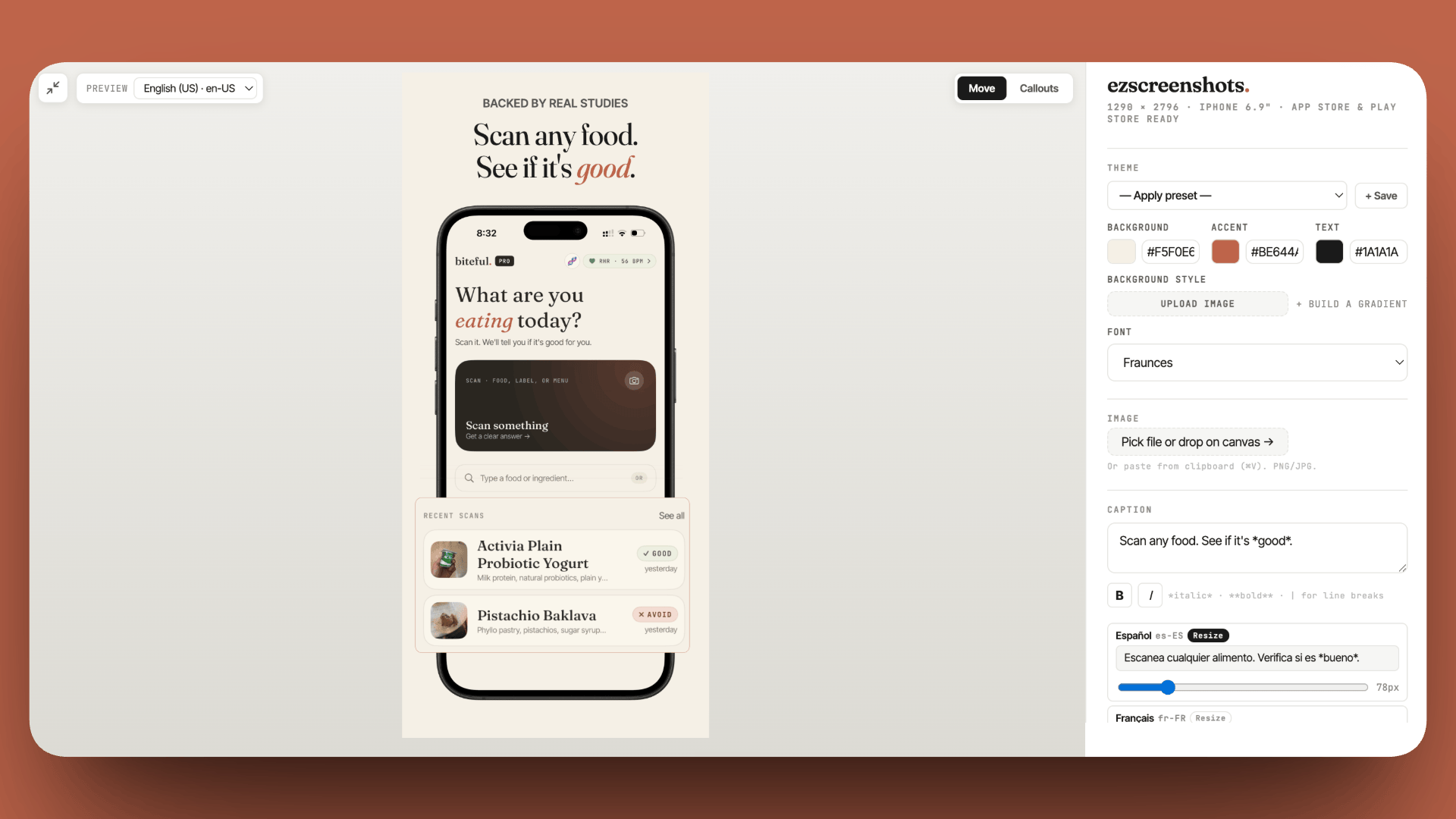
Rewrite your listing before scaling traffic
More impressions on a converting listing compounds. More impressions on a non-converting one don't. Change "Budget Tracker" to "Know where every dollar went." Drop in your Simulator screenshot, add the outcome caption, export at the right dimensions. Free, no account needed.
Try ezscreenshots →Summary
- Silence is a diagnosis problem, not a verdict — treat it as a signal that requires investigation before any rebuild decision
- Five conversations before any pivot — find real target users and ask: "What do you think this does?" / "Would you pay for this?" / "What would make you trust it enough to sign up?"
- Features vs pain language — the most common fix after a silent launch is rewriting messaging from what the product is to what the user's life looks like after using it
- Survival grinding over growth hacking — manual DMs, community presence, solving the problem for one person completely — this comes before anything that scales
- Pivot vs persevere signals are distinct — people understand but won't commit = credibility/distribution problem; problem isn't acute enough = market signal; diagnose before acting
- Go where users already are — not where it's convenient to post
- App Store recovery sequence: check conversion rate → rewrite first screenshot caption as outcome → rewrite subtitle → add App Preview video → then drive traffic